
 Trading Strategies
 Price Action analysis
 Risk Management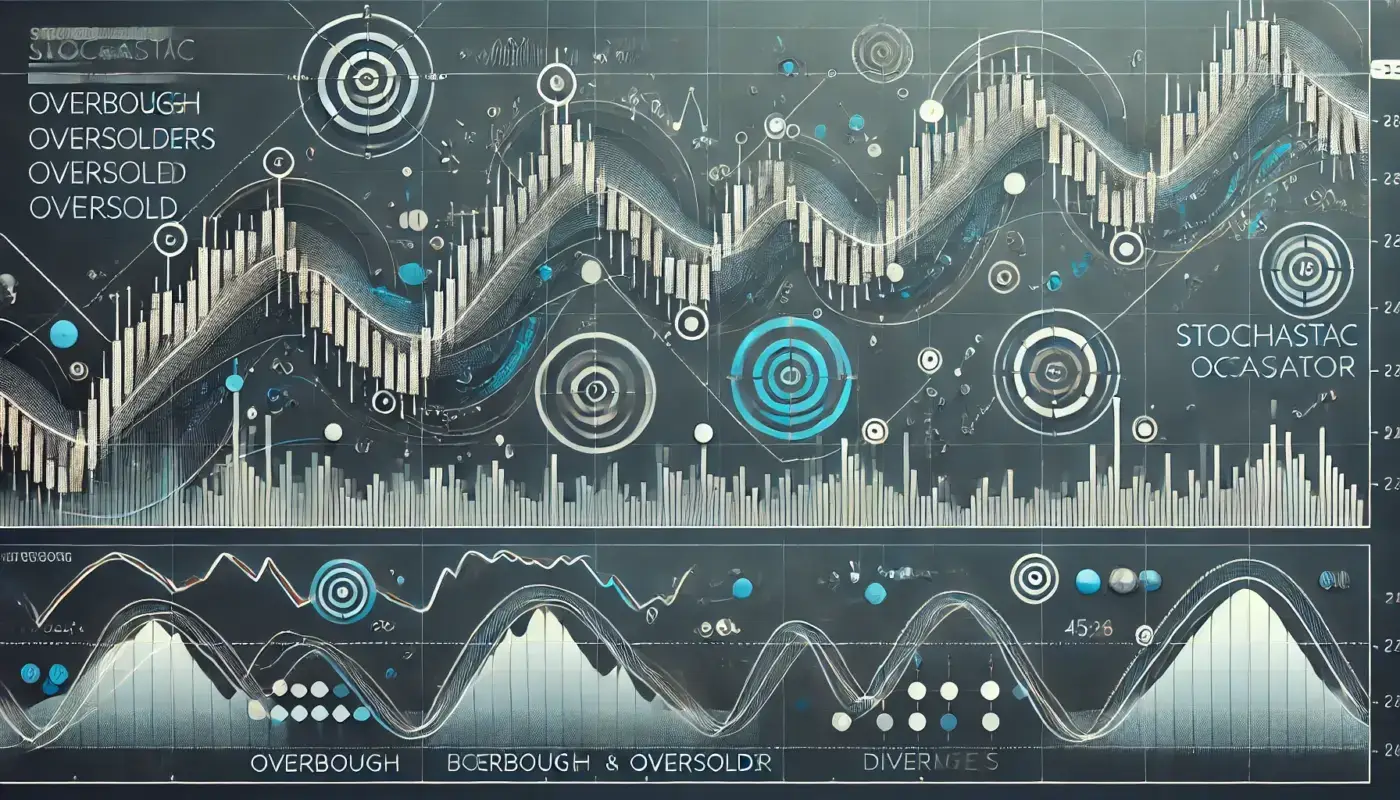
What is the Stochastic Indicator?
The Stochastic Indicator is a powerful momentum tool used in technical analysis. It helps traders determine whether a market is overbought or oversold, providing valuable insights into potential price reversals. Since market movements are often driven by momentum, this indicator is essential for traders looking to time their entries and exits effectively.
Table of Contents
- Introduction to the Stochastic Indicator
- Understanding the Stochastic Formula
- Types of Stochastic Indicators (Fast, Slow, and Full)
- How to Use Stochastic in Trading
- Stochastic Trading Strategies
- Best Settings for Different Trading Styles
- Common Mistakes Traders Make
- Combining Stochastic with Other Indicators
- Stochastic Divergences: A Powerful Trading Signal
- FAQs About Stochastic Indicator
- Final Thoughts
1. Introduction to the Stochastic Indicator
The Stochastic Oscillator is a widely used momentum indicator that helps traders identify trend reversals and potential entry/exit points. It was developed by George C. Lane in the 1950s and is based on the principle that momentum changes before price does.
Why is the Stochastic Indicator Powerful?
✅ Helps traders spot overbought and oversold conditions.
✅ Works well for identifying reversals and trend exhaustion.
✅ Generates buy and sell signals based on price momentum.
✅ Useful for divergence trading to predict price movements.
✅ Can be used in all markets (stocks, forex, crypto, commodities).
2. Understanding the Stochastic Formula
The Stochastic Indicator consists of two main components:
- %K Line (Fast Stochastic Line): Measures the current price relative to the high-low range over a given period.
- %D Line (Signal Line): A 3-period moving average of %K, used to generate signals.
Stochastic Formula:
%K=(CurrentClose−LowestLow)(HighestHigh−LowestLow)×100\%K = \frac{(Current Close – Lowest Low)}{(Highest High – Lowest Low)} \times 100
Where:
🔹 Current Close = Latest closing price
🔹 Lowest Low = Lowest price over the chosen period (e.g., 14 days)
🔹 Highest High = Highest price over the same period
The %D line is calculated as:
%D=3-period moving average of %K\%D = 3 \text{-period moving average of } \%K
Interpreting the Stochastic Values
📌 Above 80 → Market is overbought, potential downward reversal.
📌 Below 20 → Market is oversold, potential upward reversal.
📌 Crossovers → When %K crosses above %D, it’s a buy signal. When %K crosses below %D, it’s a sell signal.
3. Types of Stochastic Indicators
There are three main variations of the Stochastic Indicator:
1. Fast Stochastic
- Uses the raw %K calculation (more responsive, but generates more false signals).
- Recommended for short-term traders looking for fast signals.
2. Slow Stochastic
- Applies a 3-period smoothing to %K, making it less volatile.
- Ideal for swing traders who want more reliable signals.
3. Full Stochastic
- Allows traders to customize the %K and %D periods.
- Best for traders who prefer tuning the indicator to their strategy.
4. How to Use Stochastic in Trading
The Stochastic Indicator is best used in trend-following and reversal trading strategies.
Key Trading Signals:
🔹 Overbought Zone (Above 80): Potential sell signal.
🔹 Oversold Zone (Below 20): Potential buy signal.
🔹 Bullish Crossover: %K crosses above %D → Buy signal.
🔹 Bearish Crossover: %K crosses below %D → Sell signal.
5. Stochastic Trading Strategies
1. Overbought & Oversold Strategy
- Buy when the indicator drops below 20 and then rises above it.
- Sell when it crosses below 80 after being overbought.
2. Stochastic Crossover Strategy
- Enter a buy trade when %K crosses above %D.
- Enter a sell trade when %K crosses below %D.
3. Stochastic Divergence Strategy
- Bullish Divergence: Price makes lower lows, but Stochastic makes higher lows → Strong buy signal.
- Bearish Divergence: Price makes higher highs, but Stochastic makes lower highs → Strong sell signal.
6. Best Settings for Different Trading Styles
🔹 Scalping: (5, 3, 3) – Generates fast signals but more noise.
🔹 Swing Trading: (14, 3, 3) – Balances speed and reliability.
🔹 Long-Term Trading: (21, 5, 5) – Reduces false signals.
7. Common Mistakes Traders Make
❌ Ignoring the trend – Always trade with the trend, not against it.
❌ Overtrading – Too many signals can lead to bad trades.
❌ Not confirming signals – Use Stochastic with other indicators.
❌ Using the wrong settings – Adapt settings to market conditions.
8. Combining Stochastic with Other Indicators
📊 RSI (Relative Strength Index) – Helps confirm overbought/oversold conditions.
📊 MACD (Moving Average Convergence Divergence) – Confirms momentum shifts.
📊 Moving Averages – Helps identify trend direction.
9. Stochastic Divergences: A Powerful Trading Signal
A divergence occurs when price moves in the opposite direction of the Stochastic Indicator.
Bullish Divergence (Buy Signal)
- Price forms lower lows, but Stochastic forms higher lows.
- Indicates upcoming bullish reversal.
Bearish Divergence (Sell Signal)
- Price forms higher highs, but Stochastic forms lower highs.
- Indicates upcoming bearish reversal.
10. FAQs About Stochastic Indicator
1. What is the best Stochastic setting for day trading?
For day trading, use 5,3,3 for quicker signals.
2. Can the Stochastic Indicator be used in Forex and Crypto?
Yes, it works well in Forex, Crypto, Stocks, and Commodities.
3. Is Stochastic better than RSI?
Both are useful, but Stochastic is better for short-term momentum, while RSI is better for trend confirmation.
4. How do I avoid false signals?
Use Stochastic with MACD, RSI, or Moving Averages for confirmation.
11. Final Thoughts
The Stochastic Indicator is a powerful trading tool for spotting momentum shifts and trend reversals. By mastering its signals, combining it with other indicators, and avoiding common pitfalls, you can improve your trading accuracy and profitability. 🚀
📌 Ready to take your trading to the next level? Start applying Stochastic strategies today! 📈
The Stochastic Indicator is a powerful momentum tool that helps traders identify trend reversals, overbought/oversold levels, and high-probability trade setups. 🚀 Master it to level up your trading game!
Contents
- 1 Table of Contents
- 2 1. Introduction to the Stochastic Indicator
- 3 2. Understanding the Stochastic Formula
- 4 3. Types of Stochastic Indicators
- 5 4. How to Use Stochastic in Trading
- 6 5. Stochastic Trading Strategies
- 7 6. Best Settings for Different Trading Styles
- 8 7. Common Mistakes Traders Make
- 9 8. Combining Stochastic with Other Indicators
- 10 9. Stochastic Divergences: A Powerful Trading Signal
- 11 10. FAQs About Stochastic Indicator
- 12 11. Final Thoughts