

 Trading Strategies
 Price Action analysis
 Risk Management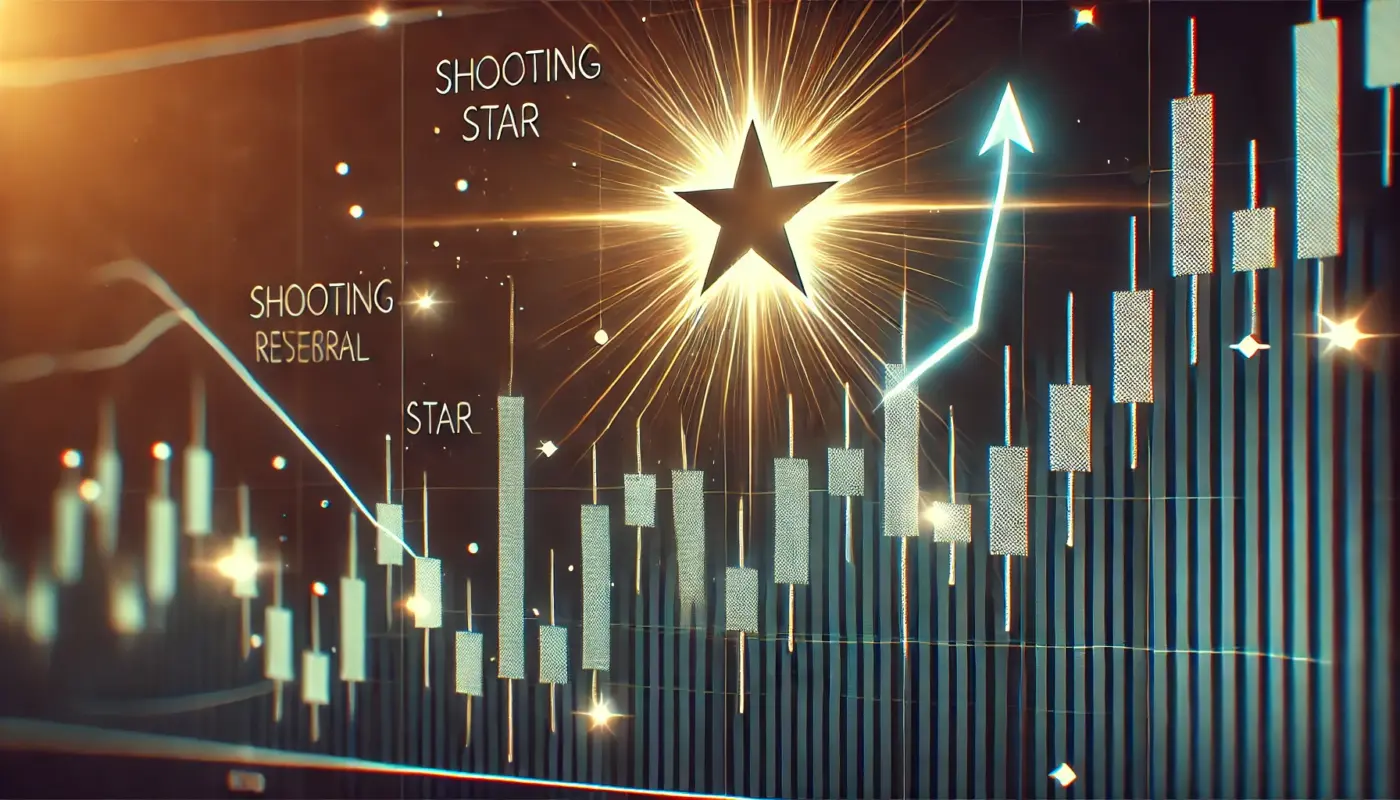
What is a Shooting Star Candlestick?
The Shooting Star is a bearish reversal candlestick pattern that forms at the top of an uptrend. It signals potential selling pressure and often precedes a price decline.
Key Features of a Shooting Star:
- Small Lower Body: Tiny real body (red or green) at the bottom of the candle.
- Long Upper Shadow: Upper wick 2–3x longer than the body.
- Minimal Lower Shadow: Little to no lower wick.
- Trend Context: Must appear after a sustained uptrend.
Psychology Behind the Shooting Star Candlestick
- Buyer Exhaustion: Bulls attempt to push prices higher but fail to hold gains.
- Selling Pressure: Bears regain control by the close, rejecting higher prices.
- Reversal Warning: Indicates potential trend reversal from bullish to bearish.
How to Trade the Shooting Star Candlestick
- Wait for Confirmation:
- Enter a short position only if the next candle closes below the Shooting Star’s low.
- Example: If the Shooting Star forms at 150, waitforaclosebelow148.
- Combine with Indicators:
- RSI Overbought: Look for RSI > 70 to confirm overbought conditions.
- Volume Analysis: Higher volume strengthens the pattern’s reliability.
- Risk Management:
- Stop-Loss: Place above the Shooting Star’s high.
- Risk-Reward Ratio: Aim for at least 1:2.
Shooting Star vs. Inverted Hammer: Key Differences
| Feature | Shooting Star | Inverted Hammer |
|---|---|---|
| Trend Context | Top of an uptrend | Bottom of a downtrend |
| Signal | Bearish reversal | Bullish reversal |
| Body Color | More impactful if red | More impactful if green |
Real-World Example
- Asset: Amazon (AMZN) – January 2024
- Pattern: Shooting Star at $180 after a 30% rally.
- Outcome: Price dropped 15% over the next 10 sessions.
- Confirmation: Next candle closed below $175 with rising volume.
Pro Tips for Traders
- Trade Shooting Stars near key resistance levels for higher-probability setups.
- Avoid during earnings announcements or major news to reduce false signals.
- Combine with moving averages (e.g., EMA 200) to confirm trend exhaustion.
Final Takeaway:
The Shooting Star is a critical tool for spotting bearish reversals, but always confirm with follow-up price action. Use it alongside volume analysis and momentum indicators to filter low-quality signals and enhance trading precision.
FAQ: Shooting Star Candlestick Pattern
A Shooting Star is a bearish candlestick pattern that signals a potential reversal after an uptrend. It suggests that buyers pushed the price higher during the session, but sellers regained control and drove the price back down, leaving a long upper wick and a small real body near the low.
1. What is a Shooting Star candlestick?
A Shooting Star is a single candlestick pattern with the following characteristics:
- Small real body (near the bottom of the range)
- Long upper shadow (wick) (at least 2x the body size)
- Little to no lower shadow
- Appears after an uptrend
- Suggests a potential bearish reversal
2. What does the Shooting Star pattern indicate?
- Buyers pushed prices higher, but sellers took control and pushed them back down.
- It signals that bullish momentum is weakening.
- It does not guarantee a reversal but suggests caution for long positions.
- Traders look for confirmation (e.g., a bearish candle after the Shooting Star).
3. How do you identify a valid Shooting Star?
✔ Forms after an uptrend
✔ Has a long upper wick (at least twice the body size)
✔ Small real body (red or green, but red is stronger)
✔ Little to no lower wick
4. What’s the difference between a Shooting Star and an Inverted Hammer?
- Shooting Star – Appears after an uptrend (bearish reversal signal).
- Inverted Hammer – Appears after a downtrend (bullish reversal signal).
- Both have a long upper wick, but their meaning depends on the trend.
5. What is the best confirmation for a Shooting Star Candlestick?
A Shooting Star alone is not enough for a trade. Look for:
✅ A bearish candle after the Shooting Star (e.g., a red candle closing below the Shooting Star’s low)
✅ High trading volume on the Shooting Star
✅ Resistance levels near the wick (showing rejection)
✅ Technical indicators like RSI overbought or a bearish MACD crossover
6. Where is the best entry point after a Shooting Star?
📉 Aggressive Entry: Sell at the open of the next candle.
📉 Conservative Entry: Sell when the next candle breaks below the Shooting Star’s low.
📉 Confirmation Entry: Wait for a full bearish pattern (e.g., a bearish engulfing or continued lower closes).
7. Where should you set your stop loss?
🔹 Above the Shooting Star’s high (to protect against false signals).
🔹 If shorting, use trailing stops if the price moves in your favor.
🔹 Consider risk-reward ratio (1:2 or better) before entering a trade.
8. What are the common mistakes when trading a Shooting Star Candlestick?
❌ Ignoring confirmation – Always wait for the next candle.
❌ Trading in a strong uptrend – If the trend is strong, reversals are less reliable.
❌ Not considering volume – Low-volume Shooting Stars are weaker signals.
❌ Ignoring support levels – Price may not drop significantly if strong support exists below.
9. Can a Shooting Star be bullish?
No, a Shooting Star is a bearish reversal pattern. However, if the next candles break above the high of the Shooting Star, it invalidates the bearish signal and may indicate continued bullish momentum.
10. Does a Shooting Star work in all timeframes?
Yes, but its reliability increases in higher timeframes (1-hour, 4-hour, daily, weekly charts).
Shorter timeframes (e.g., 1-minute or 5-minute) are more prone to false signals.
11. What are the best indicators to use with the Shooting Star Candlestick?
📊 RSI (Relative Strength Index) – Overbought conditions strengthen the signal.
📊 MACD (Moving Average Convergence Divergence) – A bearish crossover adds confirmation.
📊 Volume – Higher volume on the Shooting Star candle makes it more valid.
📊 Support/Resistance levels – If the Shooting Star forms at a strong resistance, it’s a stronger signal.
12. Can a Shooting Star be part of a larger pattern?
Yes! It often appears in:
🔹 Evening Star Pattern (a three-candle bearish reversal)
🔹 Double Top Formation (if it appears at the second peak)
🔹 Bearish Engulfing Setup (if followed by a strong red candle)
13. How often does a Shooting Star lead to a reversal?
- Success depends on trend strength, volume, and confirmation.
- Higher timeframes improve reliability.
- If major support exists, the reversal might be weak.
- Always check other technical factors before trading it.
Contents
- 1 What is a Shooting Star Candlestick?
- 1.1 Psychology Behind the Shooting Star Candlestick
- 1.2 How to Trade the Shooting Star Candlestick
- 1.3 Shooting Star vs. Inverted Hammer: Key Differences
- 1.4 Real-World Example
- 1.5 Pro Tips for Traders
- 1.6 FAQ: Shooting Star Candlestick Pattern
- 1.7 1. What is a Shooting Star candlestick?
- 1.8 2. What does the Shooting Star pattern indicate?
- 1.9 3. How do you identify a valid Shooting Star?
- 1.10 4. What’s the difference between a Shooting Star and an Inverted Hammer?
- 1.11 5. What is the best confirmation for a Shooting Star Candlestick?
- 1.12 6. Where is the best entry point after a Shooting Star?
- 1.13 7. Where should you set your stop loss?
- 1.14 8. What are the common mistakes when trading a Shooting Star Candlestick?
- 1.15 9. Can a Shooting Star be bullish?
- 1.16 10. Does a Shooting Star work in all timeframes?
- 1.17 11. What are the best indicators to use with the Shooting Star Candlestick?
- 1.18 12. Can a Shooting Star be part of a larger pattern?
- 1.19 13. How often does a Shooting Star lead to a reversal?