

 Trading Strategies
 Price Action analysis
 Risk Management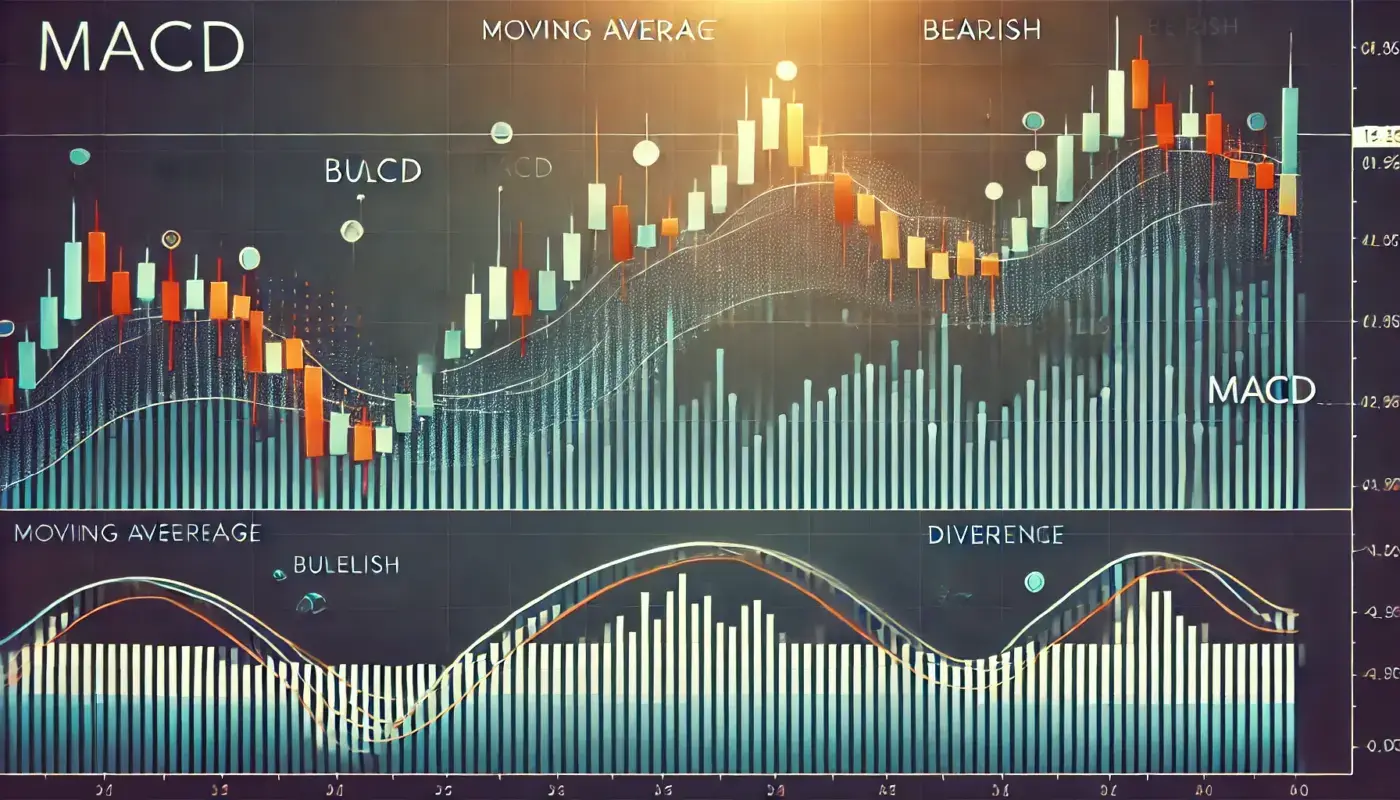
Understanding the MACD Indicator
The Moving Average Convergence Divergence (MACD) Indicator is one of the most widely used tools in technical analysis. It helps traders identify trend direction, momentum, and potential reversal points in forex, stock, and crypto markets. By analyzing the relationship between moving averages, MACD generates powerful buy and sell signals.
How the MACD Indicator Works
The MACD consists of three key components:
- MACD Line – The difference between the 12-day and 26-day Exponential Moving Averages (EMA).
- Signal Line – A 9-day EMA of the MACD line, used to generate trading signals.
- Histogram – Represents the difference between the MACD Line and Signal Line, showing momentum strength.
MACD Trading Strategies
1. MACD Crossovers
- Bullish Crossover: When the MACD line crosses above the signal line, it indicates a potential buy signal.
- Bearish Crossover: When the MACD line crosses below the signal line, it suggests a sell signal.
2. MACD Divergence
- Bullish Divergence: When price forms lower lows while MACD forms higher lows, it signals a possible trend reversal to the upside.
- Bearish Divergence: When price forms higher highs but MACD forms lower highs, it warns of a potential bearish reversal.
3. MACD Histogram Analysis
- A growing histogram suggests increasing momentum.
- A shrinking histogram signals weakening momentum and possible trend exhaustion.
Advantages of Using the MACD Indicator
- ✅ Simple and effective for identifying trend direction.
- ✅ Useful in multiple markets, including forex, stocks, and cryptocurrencies.
- ✅ Helps confirm other technical indicators like RSI and moving averages.
- ✅ Works well for both short-term and long-term trading.
The default MACD settings (12, 26, 9) work well for most markets, but traders may adjust them based on their trading style. While MACD is a powerful tool, combining it with support & resistance levels, RSI, or moving averages improves accuracy. Use MACD in combination with price action and wait for confirmation signals before entering a trade. Yes! Many day traders use MACD on shorter timeframes (5m, 15m, 1H) to capture quick price movements. MACD measures trend momentum, while RSI identifies overbought and oversold conditions.FAQ: Frequently Asked Questions